Written by Chad Roope, CFA ®
Chief Investment Officer
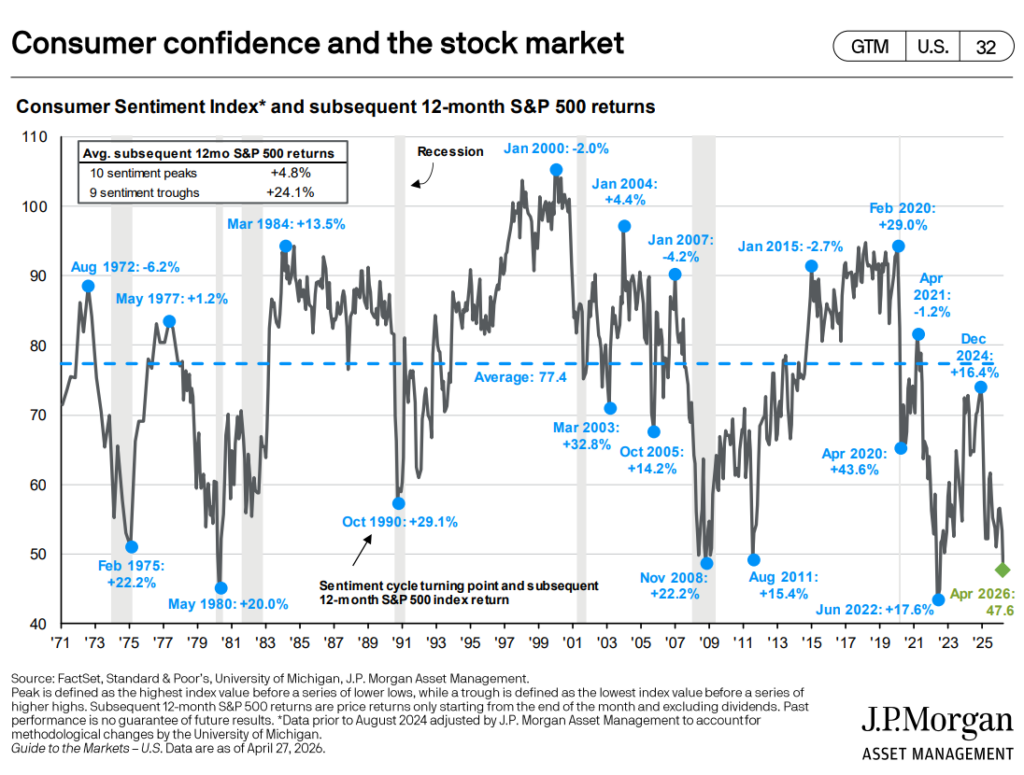
Consumer sentiment weakened sharply in April, with the University of Michigan Consumer Sentiment Index falling to 47.6, one of the lowest readings on record. The decline reflects a broad deterioration in how households view both current economic conditions and the outlook ahead.
Inflation concerns remain front and center, with expectations for future price increases rising. Geopolitical uncertainty, including ongoing tensions in the Middle East, has heightened unease, particularly through its impact on energy prices. At the same time, consumers have become less optimistic about business conditions and their personal financial outlook.
Despite the sharp drop in sentiment, consumer behavior has remained relatively resilient. Spending has held up well, highlighting a disconnect between how consumers feel and how they are actually acting. While sentiment at these levels warrants close monitoring, especially if rising inflation expectations begin to influence real economic activity, it does not yet signal a meaningful pullback in demand.
For investors, extreme pessimism can also be important for another reason: it has often served as a contrarian signal for equities. Deeply negative sentiment readings have historically coincided with, or preceded, stronger forward returns for stocks, as much of the pessimism may already be reflected in market prices.
As shown in the chart below from J.P. Morgan, equity markets have historically performed well over the 12 months following similarly low confidence readings. In our view, April’s depressed sentiment may present a constructive opportunity for long-term equity investors.
The key is discipline. Periods of uncertainty can be uncomfortable, but they are also when long-term investors benefit most from a clear strategy, appropriate allocation, and a broader financial plan that keeps short-term emotions in perspective.