
By Mark Sipos, Director, LFG Tax
Medicare Open Enrollment starts October 15 and runs through December 7. Your mailbox is probably already filling up with plan comparisons and rate sheets. For most people, that mail pile is annoying but harmless. If you are managing a substantial retirement portfolio, this window deserves a closer look than a quick glance at premium costs.
The reason is not what most of the mailers focus on. Open Enrollment controls your coverage choice. But, what it doesn’t control is the income-based surcharge that can add hundreds of dollars a month to your premium. Those two things run on separate tracks. Understanding how they interact matters more as your financial picture gets more complex.
For affluent retirees, the most important Medicare conversation this fall may not be which plan you choose. It may be how the financial decisions you’re making now could affect what Medicare costs you two years from now.
What Open Enrollment Actually Changes
During the open enrollment window, you can join, drop, or switch a Medicare Advantage plan. You can add or drop drug coverage, or move between Original Medicare and Medicare Advantage entirely. Any change you make takes effect January 1.
What Open Enrollment doesn’t touch is your premium surcharge, if you have one. That number is set separately, based on your income. It doesn’t reset just because you picked a new plan. It’s an easy distinction to miss this time of year when every piece of mail promises to save you money.
Original Medicare and Medigap vs. Medicare Advantage: Which Fits a More Complex Retirement?
For someone with a single home and a predictable routine, the choice between Medicare Advantage and Original Medicare with a Medigap policy often comes down to network size and monthly cost. For someone splitting time between two residences, traveling often, or managing ongoing specialist care, the calculation shifts.
Original Medicare, paired with a Medigap policy, generally offers broader access to providers nationwide. Costs also tend to be more predictable, which can matter if your retirement includes months spent somewhere other than home, for example, as snowbirds. Medicare Advantage plans may offer lower premiums and additional benefits, but provider networks generally limit health care access to your local area, which can be an issue if you want to keep your current doctors or spend substantial time away from your primary residence.
There is a timing detail worth knowing if you are considering a change. Your six-month Medigap Open Enrollment Period begins the first month you’re 65 or older and enrolled in Medicare Part B, not simply the month you turn 65. During that window, insurers generally cannot use medical underwriting to deny you coverage or charge more because of health problems. After it closes, insurers in most states can use your health history to decide whether to offer you a policy, or what to charge. A few federal guaranteed-issue rights can reopen that door, such as losing employer coverage, and a small number of states, including New York and Connecticut, require insurers to accept Medigap applicants year-round regardless of health. Outside of those situations, if you enrolled in Medicare Advantage first and are now reconsidering Original Medicare with Medigap, confirm your state’s specific rules before you assume the switch will be simple.
What Is IRMAA, and What Will It Cost in 2026?
The income-related monthly adjustment amount, known as IRMAA, is a surcharge added to Medicare Part B and Part D premiums for higher earners. For 2026, the standard Part B premium is $202.90 a month. If your modified adjusted gross income exceeds $109,000 as a single filer, or $218,000 filing jointly, you will pay an additional amount on top of that base premium. The surcharge rises in tiers as income climbs further.
This is not a one-time fee. It applies every month. If you file jointly and both spouses are on Medicare, it applies to both of you. That can add a meaningful amount to your annual healthcare budget, and it rarely shows up as a line item you can plan around unless you know where the number actually comes from.
The Two-Year Lookback Most People Don’t Expect
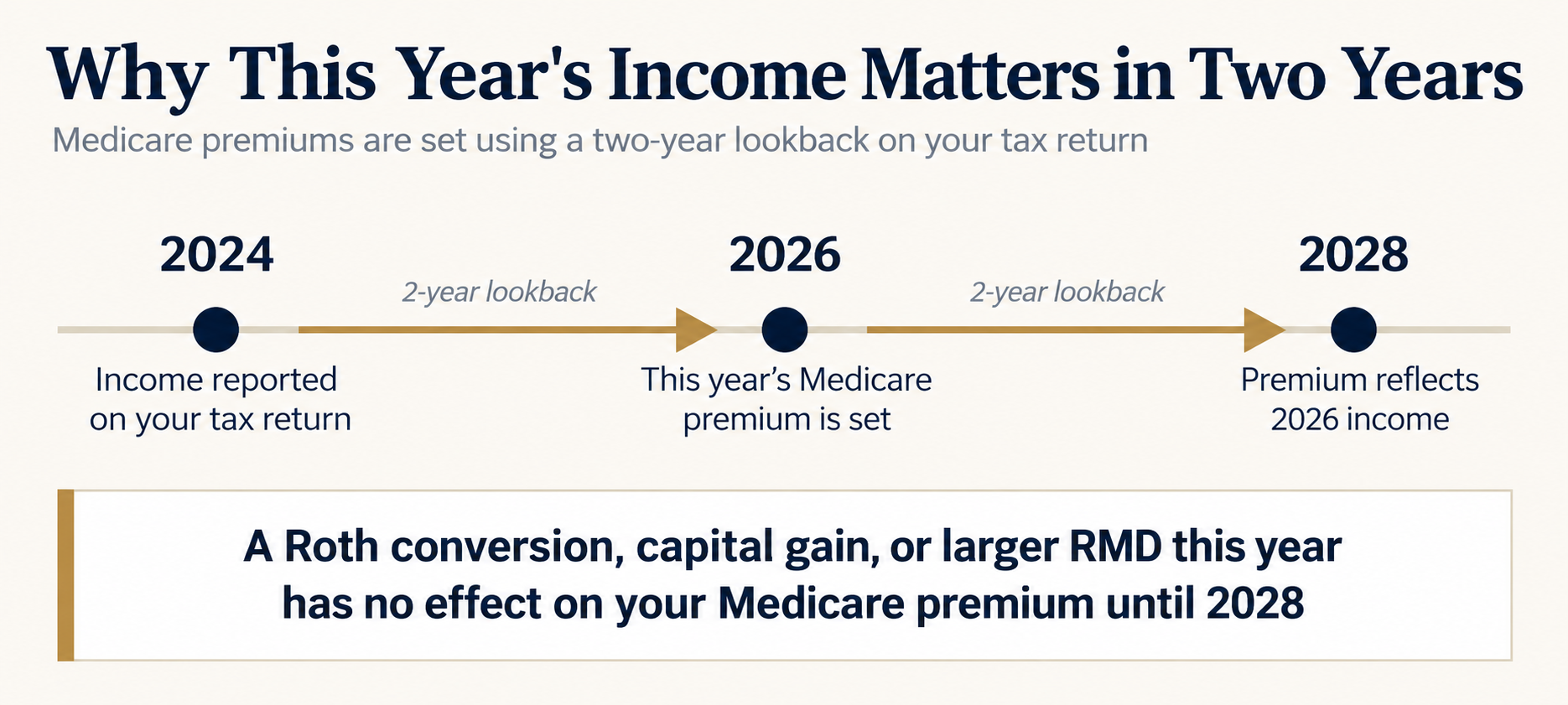
Here’s the detail that catches even financially sophisticated retirees off guard: Your 2026 Medicare premium is not based on your 2026 income. It’s based on the tax return you filed for 2024. Medicare and Social Security use a two-year lookback to set your premium. The number on your bill this year reflects decisions you made, or income you realized, two years earlier.
I often see clients open a premium notice and assume something went wrong with this year’s return, when the real cause is a Roth conversion or a large gain from two tax seasons ago that they have mostly forgotten about by the time the bill arrives.
Flip that around, and it becomes a planning opportunity rather than just a source of confusion. A Roth conversion, a large capital gain, or a bigger-than-usual required minimum distribution this year will not affect your premium in 2026. It will affect what you pay in 2028. If you are already thinking about year-end tax moves, this is the piece that often gets left out.
Medicare is one part of a broader financial picture. See how Lineweaver helps individuals and families coordinate retirement income, tax planning, investments, and other financial decisions within a comprehensive wealth strategy.
Why This Belongs in Your Year-End Planning Conversation
Most retirement checklists treat Medicare and tax planning as separate categories. In practice, a single decision, like how much you convert to a Roth IRA this December, can move both at once. Retirement itself already changes your Medicare picture in ways that are easy to overlook. Your coverage may interact with any remaining employer insurance. Your income sources also shift once steady paychecks stop.
That overlap is exactly why this conversation fits better alongside your other year-end reviews than as a separate insurance errand. A conversion that makes sense from a pure tax perspective this year might be worth adjusting, delaying, or splitting across two years. It depends on where it lands you on the IRMAA scale two years from now.
Medicare as a Line Item in Your Withdrawal Strategy
If you are drawing retirement income from several sources, a traditional IRA, a Roth account, taxable investments, and Social Security, your Medicare premium is a real cost that interacts with all of them. A higher IRMAA tier effectively raises your cost of living in a given year. That can shift how much you need to withdraw to maintain your lifestyle.
This becomes especially relevant if you are managing withdrawals across a multi-bucket strategy. The order and timing of what you draw from directly affects your reported income. Your reported income is what determines your Medicare costs two years later. Treating Medicare as a fixed, unavoidable expense misses a planning lever that is actually within your control.
What to Review This Month
A few checks now can prevent surprises later, both in your coverage and in your future premiums.
- Review the Annual Notice of Change from your current plan for cost or coverage changes taking effect January 1.
- Compare Original Medicare with a Medigap policy against your current Medicare Advantage plan if your travel or care needs have changed.
- Estimate this year’s modified adjusted gross income to see how close you are to an IRMAA threshold before December 31.
- Consider whether any planned Roth conversions or gains should be timed differently, given that this year’s income sets your 2028 premium.
- Confirm your Medigap eligibility rules if you are thinking about leaving a Medicare Advantage plan.
Make Your Retirement Decisions Work Together
Medicare decisions rarely happen in isolation. Our team can help you evaluate Medicare costs alongside taxes, retirement income, investments, and other financial priorities as part of a coordinated strategy built around your goals.
Frequently Asked Questions About Medicare Open Enrollment
Medicare Open Enrollment runs from October 15 through December 7 each year. During this window, you can switch Medicare Advantage plans, change drug coverage, or move between Original Medicare and Medicare Advantage, with changes taking effect January 1.
IRMAA is an income-related surcharge added to Medicare Part B and Part D premiums. For 2026, it applies once modified adjusted gross income exceeds $109,000 for single filers or $218,000 for joint filers, on top of the standard $202.90 Part B premium.
Medicare uses a two-year lookback to set premiums, so your 2026 premium is based on your 2024 tax return. This means income changes you make this year will not affect your costs until 2028.
You can switch coverage types during Open Enrollment, but Medigap insurers in most states may use medical underwriting outside your initial six-month enrollment window, which begins the first month you are 65 or older and enrolled in Medicare Part B, not simply the month you turn 65. A few federal guaranteed-issue rights and a small number of states, including New York and Connecticut, offer broader protections. It’s worth confirming your state’s specific rules before assuming the switch will be straightforward.
Because of the two-year lookback, a Roth conversion, a large capital gain, or a larger required minimum distribution this year can push your income into a higher IRMAA bracket two years from now, even though it has no effect on your current premium.