
By Mark Sipos, Director, LFG Tax
For most owners, a business represents far more than its value on a balance sheet. It reflects decades of decisions, relationships, risk, and sacrifice. As a sale or succession approaches, the central question often changes from “What is my business worth?” to “What do I want everything I built to accomplish after I leave?”
Business legacy planning connects the transaction to the owner’s financial plan, estate strategy, family priorities, and life after the business. The goal is to complete a successful sale while making deliberate decisions about what happens to the company, the proceeds, the people who depend on it, and the owner’s time and purpose after closing.
Those decisions become increasingly difficult to change as a transaction progresses. Starting early gives owners more opportunity to evaluate their options, involve the right professionals, and prepare their families for what comes next.
What Is Business Legacy Planning?
Business legacy planning coordinates your business transition with your financial goals, family priorities, estate plan, and vision for life after ownership. It overlaps with business succession planning and estate planning, but it asks a broader question: what do you want the wealth and values built through the business to support once your ownership changes?
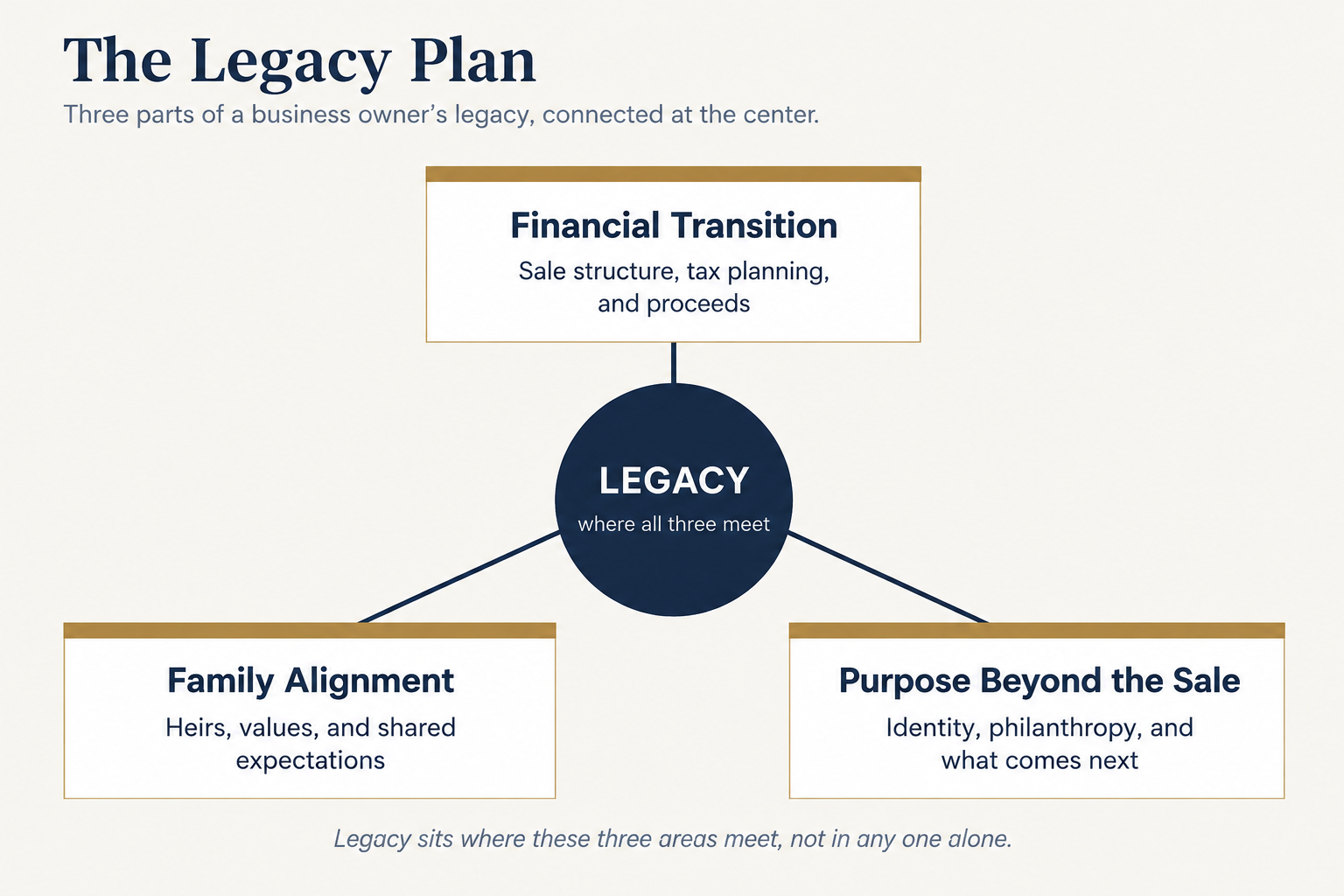
For most owners, that comes down to three things working together. Financial transition covers how the company changes hands and how proceeds fit your tax, investment, and estate plans. Family alignment covers how heirs understand the plan, especially when they’ve had different levels of involvement. Purpose beyond the sale covers what comes next.
How Does Your Exit Strategy Affect Your Legacy?
Most owners have several exit paths, each with a different mix of liquidity, control, and continuity. A third-party sale generally delivers the most liquidity. It lets you diversify wealth tied up in one company for years, but it also means giving up influence over where the business goes next.
Family succession keeps ownership in the family. But it only works if the next generation actually wants the responsibility and is ready for it. Family ownership isn’t automatically the best way to preserve a legacy. Selling the business to an outside buyer can make the proceeds easier to divide and manage, while giving each heir the freedom to pursue their own goal
An ESOP or a management buyout sits between these two options. Both often preserve jobs and culture while giving existing leadership a real stake. The mechanics get technical fast, so that conversation deserves its own time. For legacy purposes, the simpler question is which matters most to you: liquidity, control, or continuity?
Why Should Your Advisory Team Be Involved Before a Sale?
Business owners often involve their financial, tax, estate, and transaction advisors at different stages. That can create problems when a decision made for one purpose limits the options available elsewhere.
Depending on the transaction, the advisory team may include an M&A advisor or business broker, transaction attorney, estate-planning attorney, tax professional, valuation specialist, and wealth advisor. Their responsibilities differ, but their recommendations should be evaluated together.
Ideally, that coordination begins before a letter of intent is signed or the sale becomes substantially negotiated. The precise legal and tax consequences depend on the facts of the transaction, but waiting too long may limit certain estate, tax, and charitable-planning opportunities.
The lesson is not that every strategy must be completed before a letter of intent. It’s important that owners identify potential planning opportunities before the transaction reaches a stage at which those decisions are difficult, or impossible, to restructure.
Your business transition should work alongside your tax, estate, investment, and long-term financial goals. See how Lineweaver helps business owners bring these decisions together as part of a coordinated wealth strategy.
What Happens to Your Wealth After the Business Is Sold?
For many owners, the sale creates a bigger financial shift than anything they’ve experienced before. The president of the Exit Planning Institute has observed that 80% to 90% of many business owners’ personal wealth sits inside the company itself. That helps explain why your personal wealth deserves as much planning attention as the transaction itself.
Before the sale, most of that wealth exists as an illiquid ownership stake. After closing, a large piece of it becomes cash or investments almost overnight. That changes the planning conversation. Instead of asking how to grow the business, you’re suddenly deciding how much income your portfolio should produce and how much risk makes sense. The wealth plan should start before the sale, not after it. What that money needs to accomplish over the next twenty or thirty years is a separate question from the sale itself.
The Monday After Problem: Life After the Sale
Financial readiness doesn’t always mean personal readiness. For decades, the business shaped an owner’s calendar and sense of progress. Selling it can change all of that at once.
Over the years, I’ve worked with business owners who prepared carefully for the financial side of a sale, only to realize that preparing for life after the business required just as much thought. An owner might enter the transaction thinking mainly about freedom, then discover that freedom raises a new question. Freedom to do what?
That doesn’t make selling the wrong decision. It means the personal side deserves the same attention as the financial side. Some owners stay on as board members or mentors. Others start a new company or spend more time on causes they postponed. The important step is thinking through those possibilities before the first Monday morning when nobody needs you at the office.
How Can Succession Planning Reduce Family Conflict?
Family conflict after a sale rarely comes from the money itself. It usually comes from expectations that were never said out loud. One child may have worked in the company for fifteen years. Another built a separate career entirely. A third may have quietly assumed equal treatment meant equal ownership, when the parents had something different in mind.
A clear, values-based plan set well in advance gives family members room to understand decisions instead of encountering them as a surprise. Equal doesn’t always mean identical, especially when children have played very different roles. Family ownership is not automatically the best way to preserve a legacy. In some situations, selling to an outside buyer can reduce the family’s dependence on a single business and give each family member greater freedom to pursue an independent path. That groundwork is exactly what prevents surprises later.
Where Does Estate Planning Fit Into a Business Legacy Plan?
For a business owner, estate planning and succession planning overlap more than most people expect. The IRS includes business interests among the property counted in a decedent’s gross estate. That means ownership structure, gifting decisions, and trusts are all part of your broader estate strategy, not separate from it.
Small business estate planning shouldn’t sit in a different folder than your exit plan. Decisions about who owns the business, who receives the proceeds, and what remains in your estate all affect each other. Coordinating them matters most when the business represents a large share of your family’s net worth.
Can Charitable Giving Become Part of a Business Legacy?
For owners whose sale proceeds go beyond what they’ll personally need, philanthropy often becomes part of the legacy conversation. The IRS outlines how donor-advised funds let you contribute to a sponsoring charity while keeping advisory input over future grants. Many business owners use this structure to extend a sale’s impact well past their immediate family.
Timing matters here too, for the same reason it matters with your advisor team. A charitable strategy considered years before a sale can offer options that disappear once a binding deal is in place. Beyond any tax benefit, charitable planning gives the values behind your work a way to continue after ownership ends.
When Should Business Legacy Planning Begin?
If you expect to transition your business within the next several years, starting three to five years ahead creates real flexibility. Not every strategy needs that much lead time. But an earlier start gives you room to prepare family members, evaluate successors, coordinate tax and estate decisions, and think seriously about life after ownership.
If an offer is already on the table, planning still matters. The available choices are simply different. Ask yourself this: if you sold your company tomorrow, would your family, your financial plan, and your personal life actually be ready? If the answer isn’t clear, there may be more to prepare than the business itself.
When to Talk With an Advisor
You don’t need to know exactly when you will sell or who will buy the company before beginning the planning process. Consider starting the conversation if you cannot yet answer these questions:
- Who is realistically capable of owning or leading the business next?
- How much must the transaction provide to support your financial goals?
- Which outcomes matter beyond price, including employees, family ownership, culture, or community impact?
- Are your family members working from the same expectations?
- What do you want your responsibilities and daily life to look like after closing?
Uncertainty about any of these questions is often the clearest place to begin.
Plan Your Business Transition With Confidence
If you are considering selling or transitioning your business, we can help you evaluate how the transaction fits with your tax strategy, estate plan, investments, and long-term financial goals.
Frequently Asked Questions About Interest Rates and Wealth Planning
Business succession planning generally focuses on how ownership and leadership will transition. Business legacy planning takes a broader view. It connects that transition to family goals, personal wealth, estate planning, and your life after the business.
Starting three to five years before a potential transition gives you real flexibility, especially for family succession, estate strategies, or charitable planning. You can still benefit from planning closer to a sale, though some options may be more limited by then.
No. The specific strategies change with the size of the company, but the underlying questions apply broadly. Every owner needs to think through who will own the business next, how the proceeds affect their financial life, and what they want their work to represent afterward.
The team typically includes a wealth advisor, an estate attorney, a tax professional, and an M&A advisor or broker. A commercial banker may play a role too. The most important factor is coordination among everyone advising you.