
By Mark Sipos, Director, LFG Tax
If you’re 50 or older and your 401(k) contributions looked a little different this year, you aren’t imagining things. The 2026 Roth catch up rules took effect on January 1, 2026, and change how high earners save extra money for retirement in their final working years. For executives whose compensation includes bonuses, restricted stock, or other equity awards, this rule can apply even when base salary alone would not have triggered it.
The change itself is not complicated once you see how it works. What catches people off guard is who it applies to, how compensation gets measured, and how quietly it can show up on a paycheck.
What Are the 2026 Catch Up Rules?
2026 Roth Catch up rules let workers age 50 and older save more than the standard 401(k) limit each year. For 2026, that standard limit is $24,500, and eligible workers can add another $8,000 as a catch-up contribution. Until this year, you could generally choose to make that catch-up contribution pre-tax or Roth, whichever fit your tax situation better.
That changed under SECURE 2.0, which introduced several Roth 401(k) changes affecting catch-up contributions. The IRS finalized regulations in September 2025 requiring certain higher earners to make catch-up contributions on a Roth basis starting with the 2026 plan year. You still get the extra savings opportunity, but the timing of the taxes changes.
Who the $150,000 Wage Threshold Actually Affects
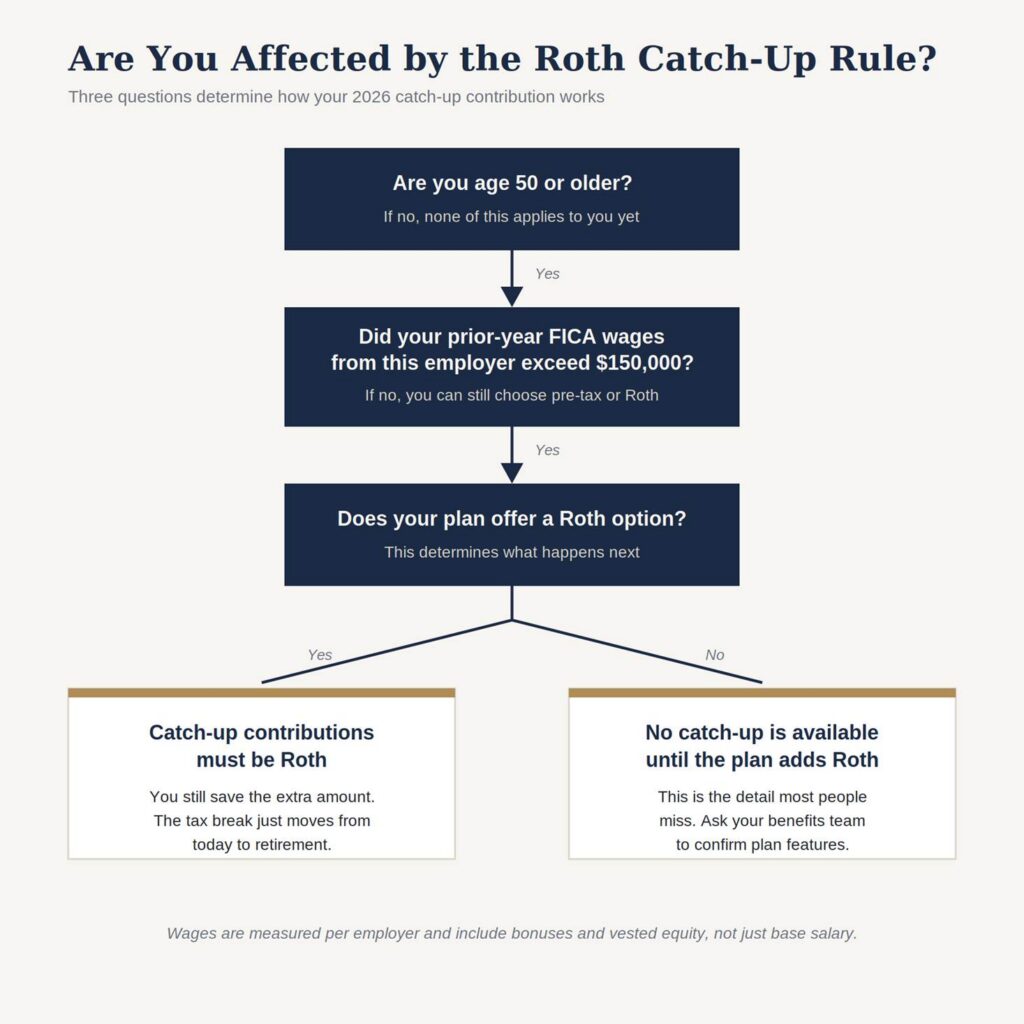
The rule applies to workers age 50 or older whose prior year wages from the employer sponsoring the plan exceeded $150,000. This is measured using FICA wages, the same figure reflected in Box 3 of your W-2, not household income or the base salary listed in your employment agreement.
IRS guidance on the new catch-up rules confirms this threshold applies per employer, not to combined earnings across multiple jobs. That distinction matters most for corporate executives. Someone earning $140,000 in base salary might assume the rule does not apply to them. Add a year-end bonus or restricted stock that vested during the year, and FICA wages can tell a very different story.
How RSUs and Bonuses Can Push You Over the Threshold
Executives tend to think about compensation in separate buckets: salary, bonus, restricted stock, options, and other incentives. Tax rules don’t sort income the same way. RSUs generally become taxable compensation the moment they vest. That income is typically subject to payroll taxes right along with your salary. Bonuses and commissions count too.
I’ve seen clients focus on base salary when thinking about retirement plan limits, only to realize later that bonuses and vested equity pushed their FICA wages well past the threshold. An executive with a modest salary but a meaningful annual RSU grant can end up above $150,000 in a year that did not feel unusually lucrative.
Your status can also shift from year to year. Vesting schedules change and bonus amounts vary. One large equity award can make this year look very different from the last. Checking your actual prior-year W-2 gives you a much clearer answer than assuming last year’s numbers still apply.
What Actually Changes on Your Paycheck
For an affected high earner, the practical change is pretty simple. Catch-up contributions must go into a Roth account inside the plan instead of being deducted from taxable income. Fidelity explains this as paying taxes now in exchange for tax-free qualified withdrawals later. That is the same trade every Roth contribution involves, just applied to money that used to get pre-tax treatment.
For someone used to making pre-tax catch-up contributions, the immediate difference is losing that current-year deduction. That can mean a smaller paycheck, even though the amount going into your retirement plan hasn’t changed. For executives already juggling bonuses, equity income, and deferred compensation, that cash flow shift deserves attention before it becomes a surprise.
What If Your Employer’s Plan Doesn’t Offer a Roth Option?
This is sometimes the detail that trips up more people than the rule itself. If you are subject to the Roth requirement, but your plan has no Roth feature, you can’t simply fall back on a pre-tax catch-up contribution instead.
Many large providers prepared for this rule well before it took effect. Don’t assume your specific plan is one of them, though. If your catch-up contribution has quietly disappeared from your paycheck this year, your benefits team or plan administrator is the right first call.
How This Affects the Age 60 to 63 “Super Catch-Up”
SECURE 2.0 also created an enhanced catch-up for workers ages 60 through 63, sometimes called the 401(k) super catch-up. The IRS confirms eligible participants in this age range can contribute up to $11,250 in 2026 instead of the standard $8,000. The Roth requirement still applies here too. An executive in this age range who exceeds the wage threshold must make the entire enhanced contribution on a Roth basis. The larger savings opportunity remains, but the tax treatment changes.
Is the Catch-Up Still Worth Making?
For most affected executives, yes, even without the immediate deduction. The contribution still fills tax-advantaged space in your retirement plan. Roth assets also give you a source of retirement income with different tax treatment than a traditional 401(k) or IRA. That difference can matter more than it seems today.
An executive approaching retirement often draws income from several places at once: a traditional 401(k), Roth accounts, taxable investments, Social Security, and sometimes deferred compensation. Having money in accounts with different tax treatment gives you more flexibility in choosing where retirement income comes from in a given year. The right answer still depends on your overall tax picture, existing balances, and time horizon. That’s why it’s worth evaluating as one piece of a broader strategy, not a reaction to the loss of a single deduction.
Your 401(k) is one part of a broader financial strategy. See how Lineweaver helps corporate executives coordinate retirement benefits, equity compensation, taxes, and investments around their long-term goals.
How This Fits Into Your Broader Compensation Strategy
For executives, this decision rarely stands alone. The same person affected by the new rule is often also managing RSU vesting, bonus timing, deferred compensation elections, and multiple retirement accounts. Those pieces interact with each other. An RSU vest raises taxable income for the year. A bonus shifts cash flow. A deferred compensation election may change when income shows up. Meanwhile, the Roth catch-up rule changes the tax treatment of yet another piece of your savings.
Each decision looks manageable on its own. The complexity comes from understanding what they add up to together. That means looking across compensation, taxes, and retirement income at the same time, rather than optimizing one account in isolation.
What Should You Check Before Year-End?
A few checks can help you avoid surprises if you think this rule may apply to you.
- Review your prior-year W-2 for your actual FICA wage figure, rather than relying on base salary alone.
- Confirm with your benefits team that your plan supports Roth contributions and ask how it’s handling 2026 catch-up elections.
- Think ahead to bonuses, RSU vesting, or other compensation events that could change your status in future years.
- Consider what the shift from pre-tax to Roth means for your cash flow and overall tax strategy this year.
When You Should Discuss With an Advisor
Not everyone affected by this rule needs a complicated plan. The conversation becomes more valuable when your 401(k) is only one piece of a larger picture: significant RSUs, a large expected bonus, a deferred compensation plan, or retirement accounts held with more than one employer. Multiple-employer situations deserve particular attention, since the rules for whose wages count can be less intuitive than they first appear.
Make Your Retirement Strategy Work Together
Retirement decisions rarely happen in isolation. Our team can help you evaluate your 401(k), taxes, equity compensation, and other financial priorities as part of a coordinated strategy built around your goals.
Frequently Asked Questions About the Roth Catch-Up Rule
It is a SECURE 2.0 requirement, finalized by the IRS in September 2025, that requires catch-up contributions from certain higher-earning employees age 50 and older to be made on a Roth basis starting with the 2026 plan year, rather than allowing a choice between pre-tax and Roth treatment.
Anyone age 50 or older whose prior-year FICA wages from a single employer exceeded $150,000. This is measured per employer and is based on FICA wages, not household income or base salary alone.
Yes. Bonuses and taxable compensation from vested RSUs are generally treated as wages and can push your FICA wages above the threshold even when your base salary would not. Reviewing your actual W-2 gives a clearer answer than looking at salary alone.
You generally cannot make any catch-up contribution, pre-tax or otherwise, until your employer adds a Roth feature. This affects only your ability to contribute above the standard deferral limit.
Yes. High earners in that age range must make their entire enhanced catch-up contribution, up to $11,250 in 2026, on a Roth basis, following the same rule that applies to the standard catch-up.