
By Jim Lineweaver, CFP®, AIF®
When the Federal Reserve moves toward higher interest rates, the headlines can make affluent families nervous. If you have spent decades building a nest egg between one and three million dollars, a shift in monetary policy is a reason to check your plan, not a reason to panic. A disciplined fixed income strategy lets you look past the short-term noise and ask a simple question: do your cash, CDs, and bonds still fit your goals? Understanding how Fed decisions move through your balance sheet over time is what makes that question easy to answer.
A rate hike rarely breaks a well-built financial plan on its own. What it does is expose the small inefficiencies that build up in a portfolio left on autopilot. Many families with significant cash leave too much of it sitting in accounts that pay less than inflation eats away. Looking closely at how rate moves affect your capital lets you make small, deliberate changes that protect your purchasing power and improve your after-tax income.
Why Rising Rates Call for a Coordinated Approach
The debate over interest rates tends to swing between two fears: a slowing economy or renewed inflation. When inflation stays above the Federal Reserve’s long-term target, as measured by the Bureau of Economic Analysis’s Personal Consumption Expenditures index, the Fed tends to hold a hawkish stance. That keeps borrowing costs elevated and slows how quickly fixed income yields fall.
For anyone near or in retirement, higher rates cut both ways. Cash and short-term holdings pay more, but inflation quietly eats into what those same dollars can buy. The best way through this is to look at your wealth as one connected system rather than a set of separate accounts. Your investment choices, your tax situation, your estate plan, and how you draw income all interact. A smart response to a Fed rate move checks all of them, not just the number itself.
What Happens to Fixed Income You Already Own
A common misunderstanding is that a rate hike automatically shrinks the value of every safe dollar you hold. The truth depends on what you own. Individual bonds and CDs behave very differently from bond funds.
If you own a fixed-rate bank CD or Treasury note, a later rate hike does not change its scheduled interest payments. A traditional bank CD retains its principal value, although withdrawing early may trigger a penalty. A Treasury note’s market value can fall as rates rise, which matters if you need to sell before maturity. At maturity, the Treasury repays the note’s face value, which may differ from what you paid. As each holding matures, you can decide where to reinvest based on current rates and your income needs.
Bond mutual funds and ETFs work differently. These funds constantly reprice their holdings to reflect current market value, so their share price can dip when new bonds enter the market paying higher rates. Investors who don’t know this distinction sometimes see paper losses in their bond fund and assume something has gone wrong. Understanding the difference between individual bonds and bond funds helps you build a portfolio that can handle a rate hike without surprises.
Your fixed income strategy should work alongside your retirement, tax, and long-term investment goals. See how Lineweaver brings these decisions together as part of a coordinated wealth strategy.
Using Staggered Maturities Instead of Guessing
Trying to time the exact peak of a rate cycle adds unnecessary stress to a retirement plan. Even professional traders who track tools like the CME FedWatch Tool, which shows how the market is pricing the odds of a Fed move, get surprised regularly as new data comes in. A better approach skips the guessing game and relies on structure instead.
Laddering is that structure. It means splitting your fixed income money across several maturities instead of one, for example six months, one year, two years, and three years. As each short-term piece matures, you reinvest it at the long end of the ladder, at whatever rate is available then.
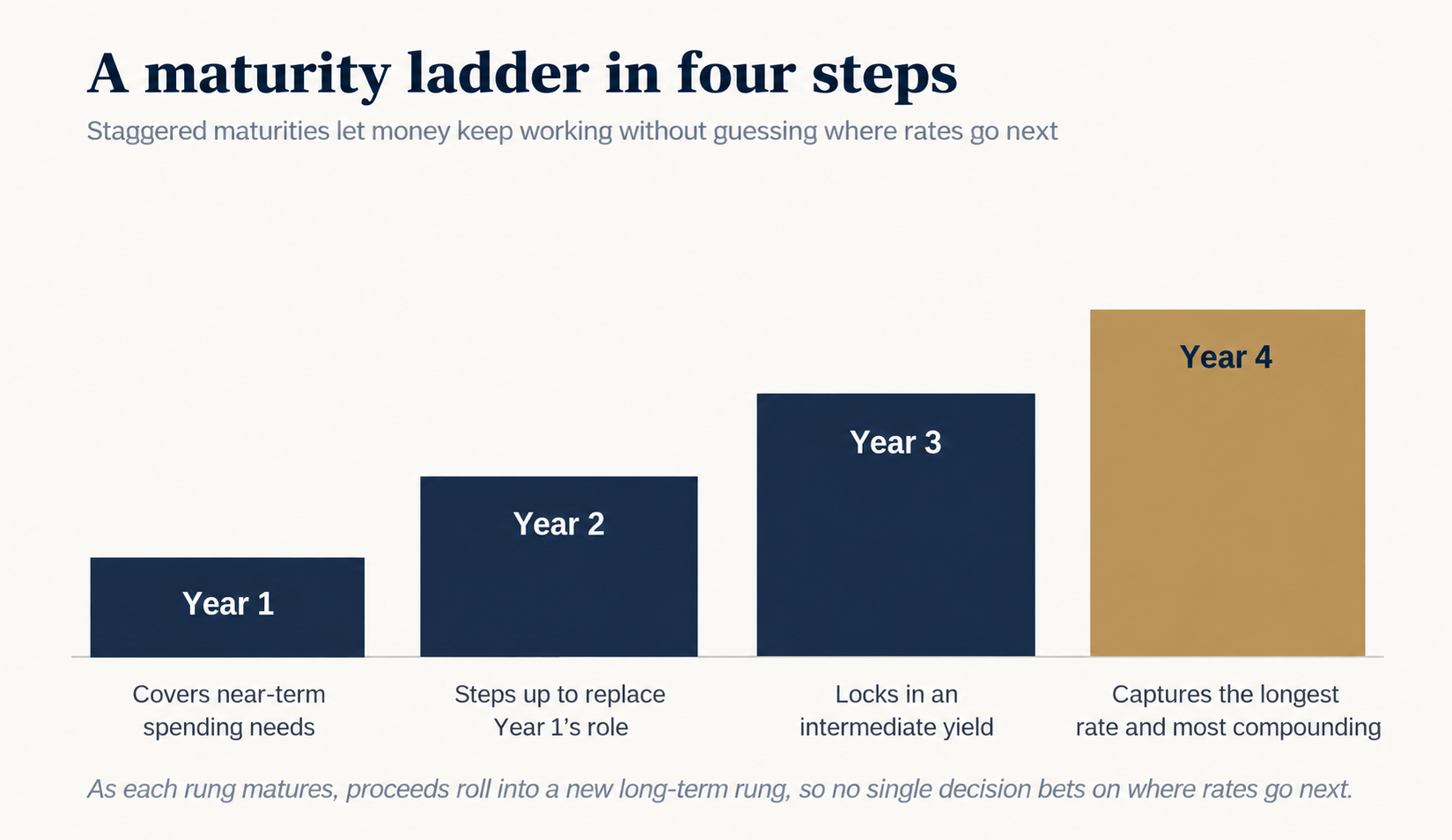
This structure gives you three real benefits. It provides steady, predictable cash for planned spending, so you’re not forced to sell growth investments during a downturn just to cover bills. It captures higher yields across your holdings if rates keep climbing. And it protects part of your income if rates eventually fall, since not all your money is locked into one low rate at the wrong time.
Coordinating Cash Flow With a Three-Bucket Strategy
A solid fixed income strategy connects your everyday spending needs with your long-term goals. Many retirees organize their money into three simple buckets.
The first bucket covers living expenses for the next one to two years. In a higher-rate environment, this bucket can actually earn a meaningful return in money market funds and short-term instruments, turning idle cash into a productive asset. The third bucket, at the other end, holds diversified stocks meant to grow your wealth and outpace inflation over the coming decades.
The middle bucket bridges the two—but in our experience with clients, it often needs the most coordination. It holds individual bonds, including municipal bonds, and CDs with maturities of three to seven years. Staggering those maturities helps you plan for upcoming income needs. As holdings mature, the proceeds can replenish your near-term bucket, reducing the need to sell growth investments during volatile markets.
Municipal Bonds and the After-Tax Math
If you’re in the 32%, 35%, or 37% federal tax bracket, the yield printed on a financial website doesn’t tell the whole story. A taxable bond paying 5% can leave you with much less after federal and state taxes take their share.
Interest from most municipal bonds is exempt from federal income tax. If you buy municipal bonds issued in your home state, that interest is often exempt from state and local taxes too. To compare a taxable bond fairly against a tax-exempt municipal bond, advisors use the tax-equivalent yield formula:
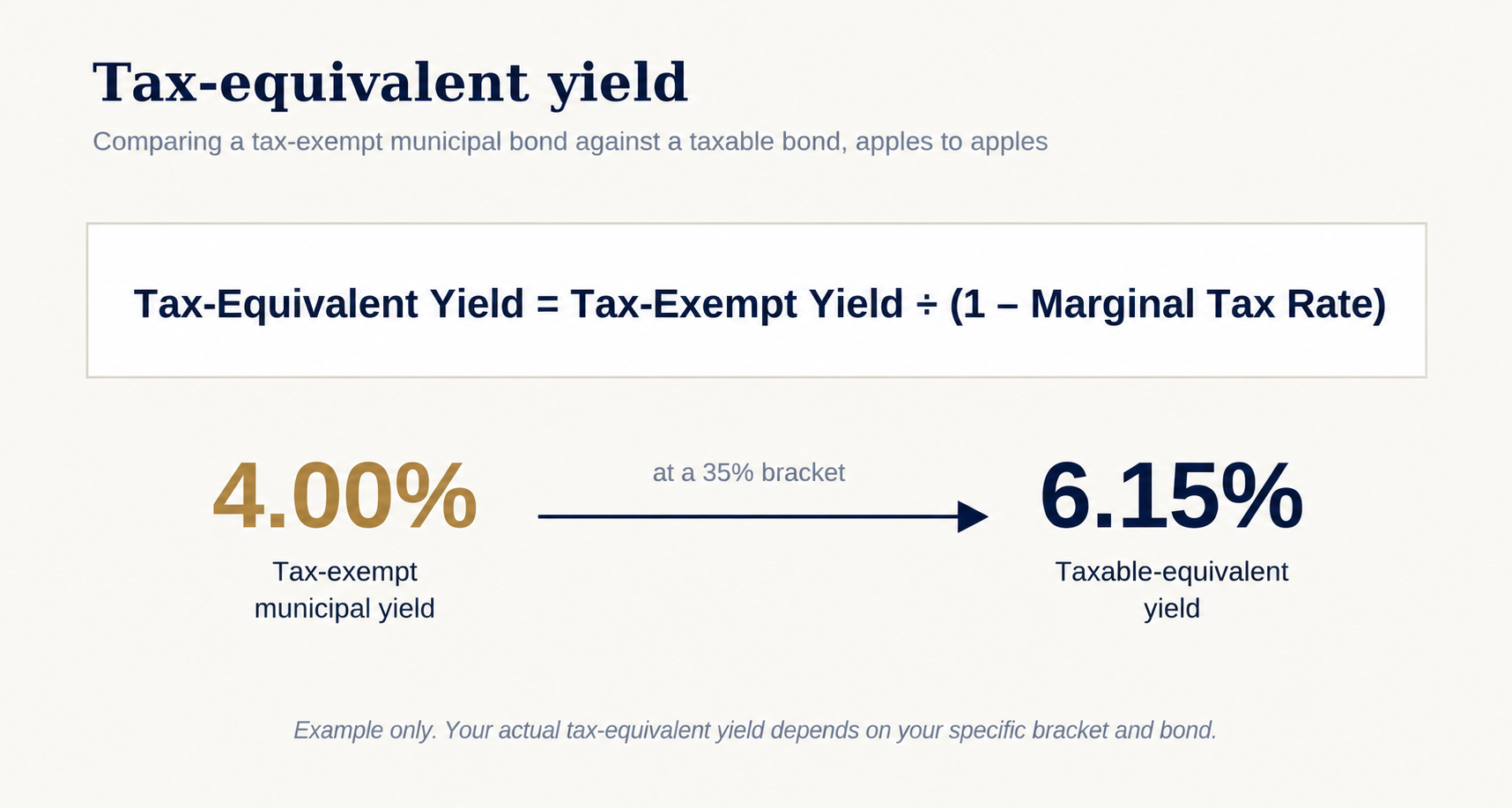
That math explains why high earners often favor municipal bonds. A 4% tax-free yield can do the same job as a much higher taxable return once you account for your bracket. One caution is worth noting: certain private activity municipal bonds can trigger the federal alternative minimum tax, a rule spelled out in IRS Publication 550. Coordinating your bond choices with your tax planning helps you avoid a surprise bill in April.
What Higher Rates Don’t Change
Fed policy dominates the financial news, but it shouldn’t dictate the core of your wealth plan. Your time horizon, spending needs, family values, and charitable goals weren’t set by a committee in Washington, and they shouldn’t be undone by one either.
A well-built plan assumes from day one that rates will rise, fall, and hold steady many times over a retirement. Chasing yield into risky or unfamiliar credit products just to keep pace with headlines usually adds risk you don’t need, right when protecting your principal matters most. The right response to a rate hike is simple maintenance: check what your cash is earning, look at your upcoming bond maturities, and confirm your mix of taxable and tax-exempt bonds still fits your current bracket.
When to Talk With Your Advisor
A shift in Fed policy is a good moment to review specific decisions on your financial calendar. If you already keep comfortable cash reserves, hold a structured bond ladder, and follow a clear income plan, one policy change rarely calls for a major overhaul.
A real conversation becomes worthwhile when something specific changes. Maybe you have a lot of cash sitting in a low-yield bank account, a large bond position coming due soon, or a question about how new tax rules affect your municipal holdings. Coordinating these decisions across your investments, taxes, and estate plan keeps your money working as hard as it can.
Put Your Fixed Income Strategy in Context
Interest rates are only one part of your financial picture. We can help you evaluate your cash, bonds, taxes, and retirement income as part of a coordinated strategy built around your broader goals.
Frequently Asked Questions About Interest Rates and Wealth Planning
A rate hike alone does not reduce the scheduled interest payments from existing fixed-rate bonds or CDs. However, their market value can decline, so selling before maturity may result in a loss. Bonds generally repay face value at maturity, assuming the issuer meets its obligations; that amount may differ from your purchase price. Callable bonds and CDs may be redeemed early. Bond mutual funds and ETFs have fluctuating share prices, and their income payments can change as their holdings change.
Laddering spreads your bond and CD maturities across several time frames. As each shorter-term holding matures, you reinvest that money at whatever the new rate happens to be, without having to guess when rates will peak. Over time, this rolling reinvestment lets your overall yield move up along with the broader rate environment.
Interest from qualifying municipal bonds is exempt from federal tax, and often from state tax if you buy bonds from your home state. Since the value of that tax break grows with your tax bracket, municipal bonds frequently pay more after taxes than a taxable bond with the same stated yield.